Source checked October 6, 2026: the linked GSA guide is Revision 1, dated January 5, 2026. Its URL retains the older initial-release filename.
The "Showstoppers" Are Here
For the 14,315 MAS contract holders identified in FY 2024, the stakes of this transition are binary: compliance or contract termination. This mandate requires contractors handling Controlled Unclassified Information (CUI) to achieve a formal Memorandum for Record (MFR) from the GSA. This is no longer a suggestion; it is a prerequisite for doing business with the federal government.
1. Takeaway 1: The "Showstopper" List – 8 Controls That Can Sink Your Contract
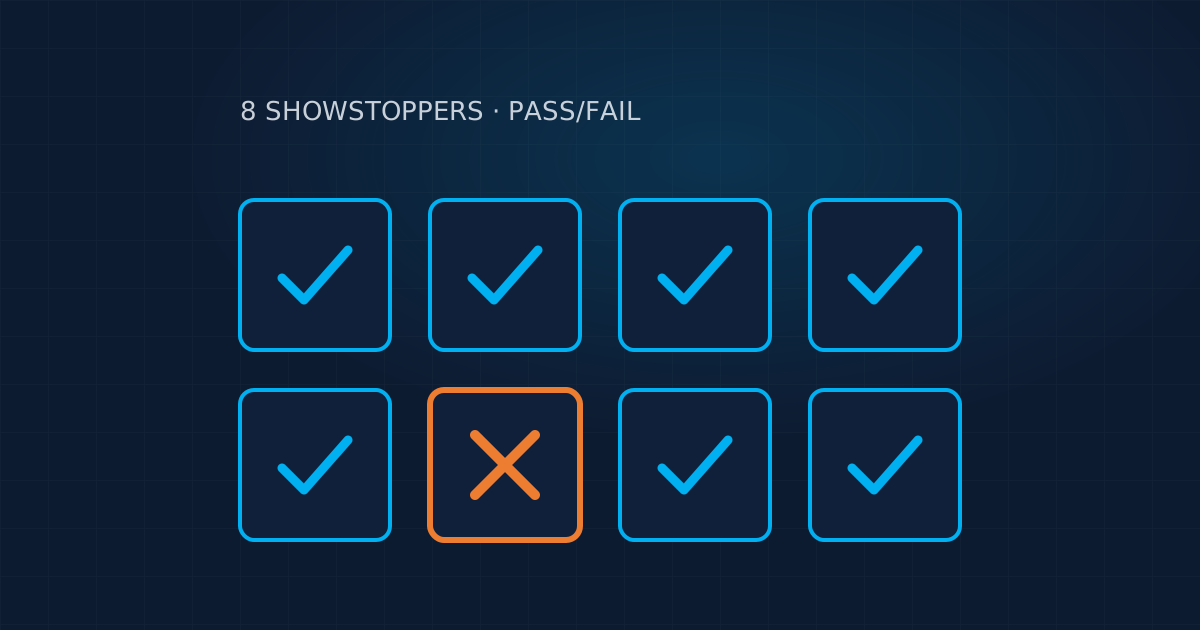
GSA has identified specific technical requirements from NIST SP 800-171 that they categorize as "showstoppers." These are non-negotiable, binary "pass/fail" gates. If your system fails to fully implement even one of these eight controls, your authorization will be rejected immediately.
- Access Enforcement (03.01.02): Organizations must strictly enforce approved authorizations for logical access to CUI. Access must be limited exclusively to authorized users and processes.
- Remote Access Control (03.01.12): All remote access must be routed through managed access control points (e.g., Jump Boxes or Bastion Hosts). Critically, jump servers must be isolated from corporate networks and utilize non-persistent connections. Split tunneling is strictly prohibited.
- Multi-Factor Authentication (03.05.03): MFA is mandatory for all privileged and non-privileged accounts. This includes all remote access (VPN/VDI) and access to Cloud Management Consoles (e.g., AWS, Azure Portal).
- Vulnerability Monitoring (03.11.02): Systems must be scanned weekly for OS vulnerabilities and monthly for web applications. Remediation is tied to strict, aggressive timelines: 15 days for internet-facing critical vulnerabilities; 30 days for High; 90 days for Moderate; and 180 days for Low.
- Boundary Protection (03.13.01): Publicly accessible components (e.g., web servers) must be logically or physically separated from internal networks using subnets or DMZs.
- Encryption (03.13.08 & 03.13.11): CUI must be encrypted both in transit and at rest. Contractors must use FIPS-validated encryption modules (FIPS 140-2 or 140-3). Standard commercial encryption is insufficient if it has not been validated by NIST.
- Flaw Remediation (03.14.01): Security-relevant software and firmware patches must be installed within the timeframes aligned with the vulnerability remediation schedule mentioned above.
- Unsupported/Prohibited Components (03.16.02): There is zero tolerance for end-of-life (EOL) components. Furthermore, technology from prohibited vendors—including Kaspersky Lab, Huawei, ZTE, Hikvision, Hytera, and Dahua—is strictly banned.
2. Takeaway 2: The Revision Divergence – Why CMMC Compliance Isn't Enough
A dangerous "compliance gap" is opening between GSA requirements and the Department of Defense's CMMC 2.0. While both frameworks utilize NIST SP 800-171, CMMC 2.0 currently operates under Revision 2. Conversely, GSA CIO-IT Security-21-112, Revision 1, explicitly mandates NIST SP 800-171 Revision 3.
The technical difference is profound. Revision 3 introduces Organization-Defined Parameters (ODPs), which allow the GSA to specify exact values for control implementation (e.g., specific timeframes for account lockouts or logging frequencies). These ODPs do not exist in Revision 2, meaning a system "ready" for CMMC may lack the granular configurations required by the GSA.
"Compliance with CMMC (Rev 2) does not guarantee compliance with this GSA requirement (Rev 3)."
3. Takeaway 3: The 60-Minute Clock – A Radical Reporting Window
GSA has introduced an incident reporting requirement that shifts the operational tempo from reactive to hyper-vigilant. Under the new mandate, contractors must report any suspected or confirmed incident impacting CUI to the GSA Incident Response Team within one hour of discovery.
The radical nature of this requirement lies in the word "suspected." Contractors are now legally and contractually obligated to report potential breaches even before a full investigation has confirmed an impact. This places a significant operational burden on small-to-mid-sized firms, who must now maintain 24/7 detection capabilities and a hair-trigger reporting process to avoid non-compliance.
4. Takeaway 4: FIPS-Validated or Bust – The Encryption Trap
Many contractors assume that using "AES-256" is enough to satisfy encryption requirements. Under the GSA mandate, this is a potentially expensive misconception. The advisory requires that all encryption of CUI (at rest and in transit) be performed by modules that are FIPS-validated.
Standard commercial-grade encryption modules found in many SaaS products or legacy hardware often lack this validation. As a strategist, I advise organizations to audit their cryptographic libraries immediately. The hidden costs of replacing legacy hardware or migrating to FIPS-compliant software versions can be a significant budgetary "trap" if not identified early in the authorization process.
5. Takeaway 5: The 5-Phase Lifecycle – Compliance Is Continuous
The GSA mandate formalizes a 5-phase authorization process that replaces the "one-and-done" audit mindset with a continuous lifecycle:
- Prepare: Identify CUI data types and hold a kick-off meeting.
- Document: Submit the System Security and Privacy Plan (SSPP).
- Assess: Undergo an independent assessment by a 3PAO or GSA-approved assessor.
- Authorize: GSA reviews the package and issues a Memorandum for Record (MFR).
- Monitor: Maintain security via a rigorous schedule of recurring deliverables.
The "Monitor" phase is where most organizations fail by treating compliance as a static state. To maintain an MFR, contractors must adhere to the following schedule:
Deliverable Schedule
| Frequency | Deliverables |
|---|---|
| Quarterly | Vulnerability Scan Reports (OS, Web App, Container, Database); POA&M Updates; Shared Drive Access Reviews |
| Annually | Updated System Security & Privacy Plan (SSPP); Penetration Test (Required/Recommended for internet-facing systems) |
| Every 3 Years | Full independent re-assessment by a 3PAO |
Conclusion: The Path Forward
The GSA's move toward NIST SP 800-171 Revision 3 is part of a broader federal push toward uniformity in CUI handling, established by EO 13556. This is the new standard for the federal supply chain: transparency, third-party verification, and continuous monitoring.
As these mandates take effect, every contractor must ask: Is our organization prepared to transition from "check-the-box" security to a culture of continuous, evidence-based compliance?
Need current guidance on the GSA mandate?
This post is preserved as originally published, and GSA and CUI guidance has continued to evolve since. A practitioner can map these requirements to your environment as they stand today. Or email rj@indirectit.com directly.